TL;DR: Discover the proven, scientific breakdown of sprinting and learn how to use this knowledge to get faster. We’ll reveal a proprietary framework and a local case study to show you exactly how we turn knowledge into results.
Did you know that mastering the key phases of the sprinting motion is the single most effective way to improve your speed? At DaVinci Fitness and Performance, we don’t guess—we measure. Our laser timing system and T-Apex resistance equipment provide the data to perfect every aspect of your stride. This article will break down the science of sprinting and show you how to apply it for real-world results. We’ll show you how we’ve helped athletes in Pasco County and beyond achieve their goals.

The Three Crucial Phases of Sprinting: A Scientific Breakdown
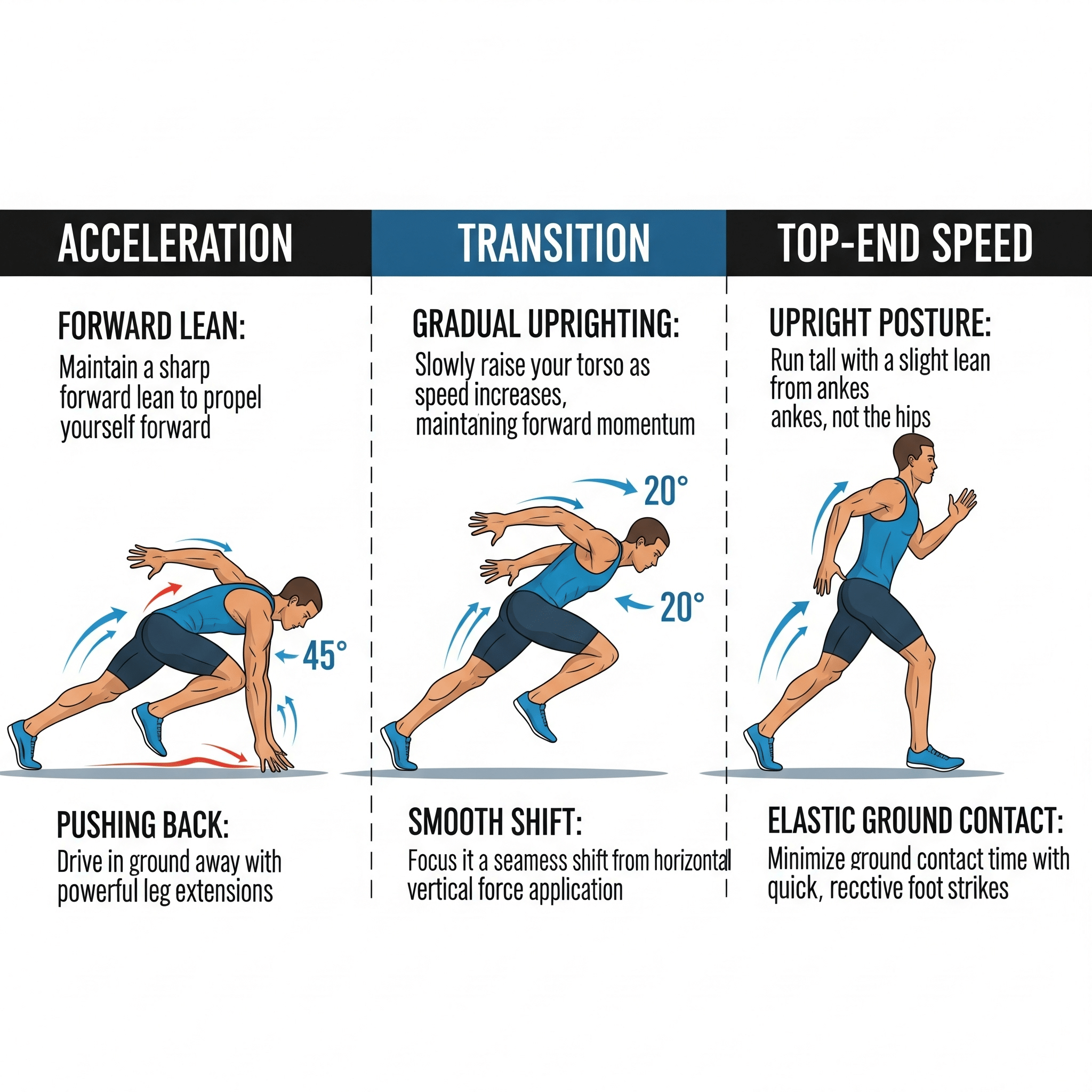
Sprinting isn’t just running fast; it’s a series of powerful, biomechanically precise movements. We view sprinting through three distinct phases: acceleration, transition, and top-end speed. Each phase demands a different set of physical abilities and technical skills. Ignoring one phase is like trying to build a house with only a hammer. Our performance training in New Port Richey addresses all three.
Phase 1: The Acceleration Phase
This is the start of your sprint, the first 10-30 meters. It’s about generating maximum force horizontally against the ground. Your body is in a forward lean, and your feet are behind your center of mass. This is where athletes often get it wrong, straightening up too early. Our training focuses on explosive power through exercises like sled pushes and broad jumps.
Phase 2: The Transition Phase
This short, but critical, phase connects acceleration to top-end speed. Your body gradually shifts from a forward lean to a more upright position. The goal here is to maintain forward momentum without losing power. We use drills like sprint float sprints to teach athletes how to smoothly transition while maintaining control and rhythm.
Phase 3: The Top-End Speed Phase
This is where you hit your peak velocity. Your body is now upright, and the focus is on a powerful, elastic ground contact with minimal time on the ground. The key here is proper mechanics: a powerful arm drive and a high knee lift. Our speed workouts in Trinity, FL, and elsewhere use tools like the fly 10m test to track and improve this phase with laser-like precision.
The DaVinci Fitness Sprint Optimization Framework
We’ve condensed decades of scientific research and real-world results into a simple, actionable system. At DaVinci Fitness, our proprietary framework focuses on data-driven improvement. This isn’t just about hard work; it’s about smart work. Here’s our proven three-step process for every athlete.
Step 1: Baseline Assessment & Analysis
First, we use our laser timing system to get a precise measurement. We perform the 30m acceleration test and the fly 10m test. This gives us a quantitative baseline and tells us exactly which phase of your sprint needs the most work. We don’t guess. We know.
Step 2: Customized Training & Targeted Drills
Based on your data, we build a tailored program. If your acceleration is lacking, we focus on strength training and plyometrics. If your top-end speed is slow, we use overspeed training with the T-Apex device. Every drill, every rep, has a purpose. We believe every athlete, regardless of their starting point, can improve with the right approach.
Step 3: Re-Measurement & Adaptation
After a training cycle, we re-test. We use the data to prove your progress and to prevent plateauing. This continuous feedback loop allows us to adjust your program in real-time. This is the core of our philosophy—constantly adapting to ensure you’re always improving.
Local Athlete Success Story: How We Improved a Running Back’s 40-Yard Dash
A local high school football player from Tarpon Springs came to us with a clear goal: shave time off his 40-yard dash. His initial laser time was good, but not great. Our athlete training in Pasco County team immediately saw a common problem. He was straightening up too early in his acceleration phase, losing valuable momentum.
Using our proprietary framework, we created a specialized plan. We used sled pulls and specific strength and conditioning exercises to build his explosive power. We then used the T-Apex system to teach him how to maintain a forward lean for longer. After just three weeks of focused training, we re-tested him. His 40-yard dash time dropped by nearly two-tenths of a second. This wasn’t guesswork; it was a data-driven result. This is the type of transformation we see every day.
FAQs About Speed Training
What are the key phases of the sprinting motion?
The key phases are acceleration (the start), transition (the change from leaning to upright), and top-end speed (your peak velocity). Each phase requires specific training to be fully developed.
How do you measure speed improvement?
We use a state-of-the-art, fully automatic laser timing system. We track key metrics like the 30m acceleration test and the fly 10m test to provide precise, irrefutable data on your progress.
Is strength training important for sprinting?
Yes, absolutely. Sprinting speed is directly tied to the ability to generate force against the ground. Strength training, particularly in the lower body, builds the power needed to create that force and improve your acceleration.
Do you offer speed training in New Port Richey, FL for different sports?
Yes, we provide highly customized training for a wide range of sports. Our programs are tailored to the specific needs of each athlete and their sport, ensuring they get the most relevant and effective training.
How are your group training sessions structured?
In group sessions, we group athletes by ability rather than sport. This allows us to maintain a high level of intensity and effectiveness while still catering to the general needs of each training group.